I didn't know anything about physics before taking it this summer. I actually learned a lot during these six weeks and now in everyday life I see how physics play a part in everything. We learned about different relationships, units, kinematics, acceleration, projectiles, newtons laws, momentum, friction, energy, waves, and light. I really enjoyed this class because of how fun and interactive it is. I am a real hands on learner and I enjoyed all the different and interesting activities that we did. I also liked how Mr. Blake had a system where he could send us our grades every so often so we know how we are doing in the class and what we need to improve on. I also like how Mr. Blake made the class fun and it really helped pass by the time especially on the long days. I also liked leaving the class a lot to do activities outside because it is hard for me to concentrate for long periods of time just sitting in a desk and not moving. Also the blogposts were really helpful in my learning. They really helped me summarize what we learned in class and so it helped me comprehend it better by writing it down in a blogpost. I disliked how for some of the group labs I had to do them by myself because my partners/group were goofing off or doing other things while I was trying to work. I think that Mr. Blake is a really solid teacher. He really knows his stuff and always keeps entertained and allows us to ask a lot of questions if we don't understand something. He is honestly one of the better teachers that I have had. I really like his teaching style and the remotes that he brought for us from kam. And he always seemed to have a song that related to what we were learning. I wouldn't really change anything about the class its pretty solid how it is.
Thursday, July 18, 2013

Wednesday, July 17, 2013
Unit 10 yo.
In class today we learned a lot about light. We learned about Snell's law. Snell's law states that when moving from a fast medium to a slower medium, light will bend towards the normals and when moving from a slow medium to a fast medium light will bend away from the normal. We also learned about different types of rays. A parallel ray is from the object parallel to the optic axis through lens and bend through the focal point on the other side. A focal ray is from the object through the focal point on the object side through the lens then parallel. Essential rays go from the object through the center of lens then continue without bending.


Unit 10 yo
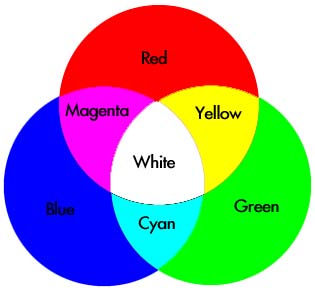
Today we learned about light properties and reflection. Light colors are different from color pigments. We learned about he three primary colors, red, green, and blue. The secondary colors and magenta, yellow and cyan. Red and Green make yellow, Green and Blue make cyan, Blue and green make magenta. And if you combine all three colors you get white. We also learned about the law of reflection which stats that the angle of incidence equals the angle of reflection and all angles are relative to the normal. The normal means it is perpendicular to the surface.
Tuesday, July 16, 2013
Unit 10
Today in class learned about light. We learned the definitions for opaque and transparent. Opaque means it doesn't let light through and transparent means light can go through it. The velocity of light is defined as "C" and is equal to 3 x 10^8 m/s. Light is an electromagnetic wave which means it does not need a medium like sound pressure waves. This means that light is faster than sound. We learned about the different frequencies like gamma rays, x-rays, uv radiation. I found it interesting that we learned that you cannot get a tan from sitting in the sun if you are protected by a glass window.


Here is picture of me and my friends with a bunch of sun light.
Sunday, July 14, 2013
Unit 9.
In class on friday we did a lab relating to sound. We used a tuning fork and hit it so that it vibrated at a frequency and it would make noise. We did this 5 times with tuning forks of different frequencies, so they made different tones each time you struck it. We would strike the tuning fork and hold it over a tube that was in water and adjusted the height of tube so that we could hear the noise it makes. We would measure how high the tube was from the water. We would use this length and multiply it by four to figure out what the wavelength was. Then we took the wave length and multiplied it by the frequency labeled on each fork to calculate the wave speed. I found this activity to be really interesting and enjoyable.


Here a picture of me holding some headphones because these headphones represent sound.
Thursday, July 11, 2013
Unit 9 Waves
Today in class we learned all kinds of new vocabulary relating to waves. We also learned about different kinds of waves. There are two types transverse waves and longitudinal waves. Transverse waves are waves that have energy perpendicular to wave velocity. Longitudinal waves are wave that have energy that moves parallel to the waves velocity. We also learned about frequency and periods. Frequency (Hertz/Hz) is how many cycles go by in a second. A period is the time it takes for one rotation or cycle to happen. Period and frequency are inversely proportional.


Here is a picture of me at sandys with a fet "wave".
Wednesday, July 10, 2013
Bottle Rocket Project
Here is a list of materials we used:
.jpg)
Here is a picture of our rocket. Our best time was 8.08 seconds.
1 2 Liter Pepsi Bottle
1 2 Liter Sierra Mist Bottle
4 Foam board fins
4 Long pieces of string
1 Trash Bag (parachute)
Duck Tape
Hot glue gun
Cardboard cone
We cut one of the bottles and attached it into the other bottle and hot glued it and duck taped it so it stays intact. We cut out fins using foam board and x-acto knife then we covered the fins in duck tape. We cut holes in the trash bag and put string through it and attached it to the bottle. We made a cone and pocked a hole in it and attached it to the rocket and stuffed our parachute inside of the cone.
Our overall rocket worked as planned but could not make the ten seconds. Our fins really worked as planned and really helped it stabilize our rocket and cut through the air. Our parachute did not always work as planned it was really inconsistent. Even when the parachute came out of the cone the parachute didn't fall accordingly. The parachute strings sometimes got tangled with each other at caused the parachute to not open fully.
The psi we launched at was about 60.
We filled up the bottle with about a third water.
This project taught me more about air resistance, velocity, gravity. I also believe that the fast, slow, stop slow fast really applies to this. I also learned that the strings of the parachutes need to be a perfect length. If its too short its not as effective, and if its too long the strings get tangled more frequently.
I would really like to do this activity again to improve my rocket and make a really solid one. This was a really fun experience and I hope I could do it again in the future.
.jpg)
Here is a picture of our rocket. Our best time was 8.08 seconds.
Water Bottle Rocket
Today our rocket consisted of one 2 Liter bottle, cardboard fins, cardboard cone and a trash bag parachute with string. We hot glued the fins on the bottle and we hot glued the the parachute strings to the bottle. We then tapped down both the fins and the strings to make sure they were super secure. We rolled up our parachute and put it in the cone. We did this so when the rocket is launched the cone will tip off and the parachute will open all fall safely to the ground. This only worked once and our time was about 5.5 seconds. We will be improving our rocket by making more sturdy fins and hopefully be adding another bottle to our rocket.


Monday, July 8, 2013
Unit 8.
Today in class we learned about Power (watts). Power is the rate of work. The formula for Power is Power = change in energy / change in time or Power = work / time. The unit for power is watts (joules/secs). After learning about power we did a lab practical using our knowledge of energy to figure out the distance our pendulum/water balloon pushed a box. We also did some worksheets that help us to figure out how to graph energy, we learned that total energy is constant when graphing energy.


This picture reminded me of what we learned today in class. Whenever I turn on my tv I press the "power" button
Sunday, July 7, 2013
Unit 8
In class on friday we started to learn about energy and how it used in physics. There are two main types of energy, kinetic energy and potential energy. Kinetic energy (KE) is the energy of motion and its formula is KE = 1/2 x mass x velocity^2. Potential energy (PEg) is gravitational energy and its formula is PEg = mass x gravity x change in height. There is also another type of energy called spring potential energy (PEs) and its formula is PEs = 1/2 x spring constant x distance spring compressed^2. We also learned about the conservation of energy which states that energy cannot be created or destroyed it can only change forms. We also learned about this new term "work" which is the change in energy.


This is a picture of the spring inside my tv remote it reminded me about spring potential energy
Wednesday, July 3, 2013
Egg Drop Lab
1) Our capsule will work because it is really light so the force of impact to the ground will be very small. With less mass the momentum will be less thus making the force less. Also the material we are using is very aerated so when it hits the ground the force is spread out throughout the block. We also added paper towel for extra padding and so it doesn't roll around in the blocks.
2) Our capsule was in free fall and accelerating at about 9.8 m/s^2. When it land the aerated material block we used increased the contact time. The paper towel also provided increased contact time so the egg would not crack. When the capsule hit the ground the aerated foam absorbed all of the force of the impact because of the increased contact time.
3) Our capsule worked because it was very light weight and the foam we used was aerated. The momentum of our capsule was less because of the low mass that we had. The foam we used increased the contact time with the ground so there would be less force acting on the egg. The paper towel worked because the slot/hole for our egg was too big for the egg so we needed to add the paper towel to make it fit the hole so that it would be snug and it also increased the contact time. If I were going to do this experiment again I would probably put a piece of cardboard under it so that the capsule would fall at a slower speed.
https://plus.google.com/photos/106546481636824512790/albums/5887051477030220641?banner=pwa

2) Our capsule was in free fall and accelerating at about 9.8 m/s^2. When it land the aerated material block we used increased the contact time. The paper towel also provided increased contact time so the egg would not crack. When the capsule hit the ground the aerated foam absorbed all of the force of the impact because of the increased contact time.
3) Our capsule worked because it was very light weight and the foam we used was aerated. The momentum of our capsule was less because of the low mass that we had. The foam we used increased the contact time with the ground so there would be less force acting on the egg. The paper towel worked because the slot/hole for our egg was too big for the egg so we needed to add the paper towel to make it fit the hole so that it would be snug and it also increased the contact time. If I were going to do this experiment again I would probably put a piece of cardboard under it so that the capsule would fall at a slower speed.
https://plus.google.com/photos/106546481636824512790/albums/5887051477030220641?banner=pwa

Here is a picture of the capsule with my group members.
Tuesday, July 2, 2013
Unit 7.
Today we continued learning about unit 7, momentum, and collisions. We did a lab practical that was similar to yesterday's lab except we used a nerf gun to shoot a bullet and collide with the cart to make it accelerate. It went through the photo gate and we collected data. Before we went on break we go to do the water balloon activity where we could see which partners could through the water balloon the farthest without it popping. My partner was Alex and we were one of the two last teams. This activity was really fun and thank god the balloon didn't splash all over me. Mr. Blake brought this really cool hover board into class and we got to see him toss a 20 lb. ball back and forth and watch him move when he caught it or threw it. He would be going on forever but there is still some friction even thought he is on a hover board.


Here is Mr. Blake on the hover board.
Monday, July 1, 2013
Unit 7
Today in class we learned about momentum. We used the air tracks to calculate of mass and velocity can affect the momentum of the cart. We did different trials with different masses, velocities, and direction. The carts would hit each other with a rubber band attachment. We also learned many different equations using momentum. Momentum is letter p and its units are kg m/s. We also learned the Law of conversation of momentum: In a closed system, momentum of a system is always conserved.
Momentum (p) = mass (m) x velocity (v)
∆P = force x time
Force = ∆ P x ∆ Time
P final - P initial = avg Force x ∆ Time
Impulse ( I or J ) = Force x ∆ Time
I = ∆ P
I = mv - mvo

Momentum (p) = mass (m) x velocity (v)
∆P = force x time
Force = ∆ P x ∆ Time
P final - P initial = avg Force x ∆ Time
Impulse ( I or J ) = Force x ∆ Time
I = ∆ P
I = mv - mvo

Heres a picture of the lab that we spent most of the day on
Thursday, June 27, 2013
Semester 1
I have learned a lot about chemistry this summer. If I had to choose one activity that was my favorite I would have to pick the Air Rocket Lab. It was amazing that the rockets could go so high just using air pressure. I also like how Mr. Blake gives us time to ask questions if we do not understand something. Units 1-4 were really straight forward and I found them to be really easy. Units 5 and 6 are hard for me because sometimes I have trouble making the diagrams and I also feel that Unit 6 was kind of rushed. Overall this semester has been great and I am looking forward to another solid one.
Unit 1 - Introduction to Physics
Pendulum Lab
Graphing relationships and functions, no relationship y=b, liner/direct y=x, inverse y=1/x, squared y= x^2, square root y=√x
Independent and Dependent variables, x = independent, y = dependent (in most cases)
Scientific Notation, 525,000 = 5.25 x 10^5
Accuracy vs. Precision, accuracy = closeness, precision = consistency
Units of Measurements,
Dimensional Analysis (converting) 6.4 hrs = 23,040 secs
Unit 2 - Kinematics: The Study of Motion
Describing graphs, Motion maps,
Velocity, V(m/s) = D/T
Displacement, distance
Instantaneous speed,
Physics Olympics,
Kinematics,
Position vs. Time, slope = velocity (graphing rule #1)
Velocity vs. Time, slope = acceleration (graphing rule #2)
The area under the curve of a VT graph is displacement (graphing rule #3)
Unit 3 - Uniform Acceleration
Instantaneous velocity,
Average Velocity,
Constant acceleration,
Gravity = 9.8 m/s^2 ≈ 10 m/s^2
DAT, d = 1/2 at^2 + vot
VAT, v = vo + at
VAD, v^2 = vo^2 + 2 ad
Unit 4 - Projectiles
Axes are independent
Vegas rule- what happens on the x-axis stays to the x-axis and
what happens on the y-axis stays on the y-axis
T charts and put Unit 3 equations to use
Unit 5 - Forces in Equilibrium
SOH CAH TOA
Trig- Sin, cos, tan
Frictional Force (Ff)
Force = Push or pul
Force Diagrams, Normal force
Newton's Laws
Unit 6 - Forces in Motion
Fnet = mg (mass x gravity)
Friction = coefficient of friction (weird M) x Normal Force
Wednesday, June 26, 2013
Unit 6
Today in class we started to learn about Unit 6 - Forces that accelerate. Newton's second law is really important in this Unit because it is the Law of acceleration. The Law of Acceleration states that the acceleration of an object is directly proportional to the net force of an object an the acceleration of an object is inversely proportional to the object's mass. If the object is lighter it accelerates faster. If the heavier it accelerates slower. Today we also learned more about force diagrams. One example Mr. Blake told us about was an elevator. For this problem we had to draw a diagram and use equations. Another thing I learned today is that we are and have been ignoring friction because it makes physics really complicated.


This is a picture of one of the problems we did in class today.
Unit 5.
In class today we learned about the rest of Newton's Laws. We learned about the Law of Acceleration and the Action Reaction Law. Law of Acceleration - The acceleration of an object is directly proportional to the net force of an object while the acceleration of an object is inversely proportional to the object's mass. Action Reaction Law - For every force there is an equal and opposite force. Equal in magnitude but opposite in direction. Today in class we also furthered our learning about friction by doing an activity with air pucks. When the puck ignored the friction of the ground it could go on forever until it was disturbed by an outside unbalanced force.


This is a picture of the notes I took for Newton's Laws
Monday, June 24, 2013
Unit 5
Today in class we learned more about trig and how we can use it to find the values when we have a triangle. We also learned new techniques to go from two vectors to one vector and to go from one vector to two vectors. We also started to learn about Newton's law of motion. Objects in motion (at rest) tend to stay in motion (at rest) unless acted upon by a unbalanced force. We also did a lab where we put a pen on a paper and tried to race with the papers to other side of the table without the pen falling. We also put a pen on a paper and tried to pull the paper from under the pen without the pen falling.


Sunday, June 23, 2013
Unit 4 Projectile Motion
On friday we furthered our learning about projectiles. We did a rocket launch lab using four different caps to make the rockets go different heights. There was low, medium, high, and super. We did three trials for each cap and then we averaged all the times. Then Mr. Blake gave us an angle and we needed to use to trig to figure out what numbers to use to plug into the formulas. We used the data from the super cap because it was the most consistent. After plugging in numbers we found and estimated distance of about 61 meters. In actuality our rocket only shot around 48 meters. I think our rocket wasn't launched as far as it could of because of the wind and also our rocket was slightly broken. I found this lab to be one of the most fun things we have done so far this summer in physics.


https://plus.google.com/photos/106546481636824512790/albums/5887051477030220641?banner=pwa
Thursday, June 20, 2013
Unit 4
Today in class we learned about projectiles. We did a lab that involved launching a ball and figuring out its velocity based on what we knew which was how far the ball was shot, the height it was shot from and the initial/original velocity. We used the information and plugged it into the formulas that we learned in the previous unit (DAT, VAT, VAD). We also learned a new rule that tells us that the axes are independent. This rule is also called the vegas rule because what happens on the x axis stays on the x axis, and what happens on the y axis stays on the y axis. We also went to the pool today and we took videos of people jumping in the pool and we uploaded the videos to logger pro and made a graph for the video and the movement of the different jumps into the pool.
Here is a picture of one of my classmates doing a backflip into the pool. The blue dots are his hip positions throughout the jump.

Here is a picture of one of my classmates doing a backflip into the pool. The blue dots are his hip positions throughout the jump.

Wednesday, June 19, 2013
Quarter 1 Review

Unit 1 - Introduction to Physics
Pendulum Lab
Graphing relationships and functions, no relationship y=b, liner/direct y=x, inverse y=1/x, squared y= x^2, square root y=√x
Independent and Dependent variables, x = independent, y = dependent (in most cases)
Scientific Notation, 525,000 = 5.25 x 10^5
Accuracy vs. Precision, accuracy = closeness, precision = consistency
Units of Measurements,
Dimensional Analysis (converting) 6.4 hrs = 23,040 secs
Unit 2 - Kinematics: The Study of Motion
Describing graphs, Motion maps,
Velocity, V(m/s) = D/T
Displacement, distance
Instantaneous speed,
Physics Olympics,
Kinematics,
Position vs. Time, slope = velocity (graphing rule #1)
Velocity vs. Time, slope = acceleration (graphing rule #2)
The area under the curve of a VT graph is displacement (graphing rule #3)
Unit 3 - Uniform Acceleration
Instantaneous velocity,
Average Velocity,
Constant acceleration,
Gravity = 9.8 m/s^2 ≈ 10 m/s^2
DAT, d = 1/2 at^2 + vot
VAT, v = vo + at
VAD, v^2 = vo^2 + 2 ad
Tuesday, June 18, 2013
Unit 3.

Monday, June 17, 2013
Unit 3

Sunday, June 16, 2013
Unit 2 Kinematics

Thursday, June 13, 2013
Unit 2

This is a photo of our Physics Olympics when Candace and I did the bunny hop event. From doing this activity we learned about velocity and instantaneous speed. We learned that velocity is the average speed that has direction and to find velocity by using the formula Velocity = Distance Traveled (m) / How long it takes to happen (secs), also velocity is the slope of a Position vs. Time graph. We learned that Instantaneous speed is the speed you are going at any given time. An example of instantaneous speed is when a police officer uses his radar gun to clock what speed you are going. From the Physics Olympics I learned that velocity is the average speed and instantaneous speed can be higher or lower than the velocity.
Wednesday, June 12, 2013
Unit 1
This is a drawing of a grandfather clock. This represents Unit 1 because we are learning about pendulums and grandfather clocks have a pendulum in them. Most grandfather clocks are the same size because the length of the pendulum needs to be a certain length in order for it to be accurate. The weight can change and it will still be accurate as we learned in the pendulum lab because the mass does not affect the time of the period. Also it does not matter at what angle the pendulum swings because that too does not affect the time of the period as we tested in the lab. This is why we see many grandfather clocks are the same size but there are the occasional small or large clocks with a proportional pendulum.


Monday, June 10, 2013
#1 Introduction
My name is Justin Smith, I live in Mililani, I'm sixteen years old and I'm going to be a junior. I have been going to Punahou since kindergarten. I enjoy playing all sports but my main sport is currently lacrosse and I also enjoy going to the beach. My progress in science thus far has been Biology and Chemistry. Next year I will be taking Algebra 2/Trigonometry and I have already taken Algebra 1 and Geometry. In the course I hope to learn what physics is and how it relates to everyday life and I also hope to have a lot of fun.
 Heres a picture of me cruising at my friend Cade's house after school writing in my physics blog.

Subscribe to:
Posts (Atom)